# Overview & Pool Types
Source: [https://docs.curve.finance/protocol/pool/overview](https://docs.curve.finance/protocol/pool/overview)
Curve offers a **permissionless** system for deploying liquidity pools — no DAO vote, no approval process, and no technical barrier beyond the gas cost to deploy. A full-featured interface is available in the Curve app, so you can launch a custom pool without writing any code.
To get started quickly, follow one of the deployment guides:
[
How to Deploy a Stableswap Pool
Learn how to deploy a Stableswap pool.
](https://docs.curve.finance/protocol/pool/guides/deploy-stableswap.md)
[
How to Deploy a Cryptoswap Pool
Learn how to deploy a Cryptoswap pool.
](https://docs.curve.finance/protocol/pool/guides/deploy-cryptoswap.md)
[
How to Deploy a FXSwap Pool
Learn how to deploy a FXSwap pool.
](https://docs.curve.finance/protocol/pool/guides/deploy-fxswap.md)
Factories make launching pools on Curve fast, flexible, and accessible to any project—whether you're a stablecoin issuer, LST protocol, synthetic-asset platform, or any other DeFi team looking to bootstrap deep, reliable liquidity.
## How are Pools Deployed?
In the background, new liquidity pools are deployed by making use of a **Pool Factory**, which essentially is a smart contract for deploying new pools. Each factory contains the logic and configuration for a specific pool type. Factories support a few different pool types:
- **Stableswap** — for pegged or correlated assets (e.g., USDC/USDT, stETH/ETH)
- **Cryptoswap** — for more volatile or uncorrelated assets (e.g., ETH/USDC)
- **FXSwap** - for lower-volatility assets like Forex pairs, or lower volatility Crypto pairs like BTC/ETH.
Once a factory is deployed, anyone can create a new pool of that type — either through the Curve UI or directly on-chain.
info
**Pool deployment is completely free of charge** beyond standard gas costs. There are no additional fees, no protocol charges, and no hidden costs associated with deploying a new pool on Curve.
Pools deployed via a factory appear automatically on the Curve frontend after a short propagation period and are picked up by aggregators such as 1inch and CowSwap. You don't need to chase integrations.
## Choosing the Right Pool Type
Curve supports multiple pool designs to fit different kinds of assets. Selecting the correct type is essential to ensure low slippage, efficient trading, and capital-efficient liquidity.
Not sure which to use? Reach out in the official Curve channels.
### Stableswap Pool
Choose a **Stableswap pool** when your assets are expected to stay close or correlated in price — e.g., stablecoins (USDC/USDT), LSTs (wstETH/stETH), or yield-bearing stable assets like sDAI. Learn more here: [Understanding Stableswap](https://docs.curve.finance/protocol/pool/understanding-stableswap.md).
Stableswap-NG pools support a wide variety of token types beyond standard ERC-20 tokens. This flexibility allows you to create pools with yield-bearing tokens, rebasing tokens, and oracle-enabled tokens.
**Supported Asset Types:**
| Type | Description | Use Cases | Examples |
| --- | --- | --- | --- |
| **0** | Standard ERC-20 | Basic tokens with no special features | USDC, USDT, DAI |
| **1** | Oracle-enabled | Tokens with rate oracles for accurate pricing | wstETH, cbETH |
| **2** | Rebasing | Tokens that change supply over time | stETH |
| **3** | ERC4626 Vault | Yield-bearing vault tokens | sDAI |
**Technical Requirements:**
- All tokens must be ERC-20 compatible (return True/revert, True/False, or None)
- Maximum 18 decimals supported
- Oracle tokens must have precision $\le 18$
- ERC4626 vaults support arbitrary precision for both vault and underlying tokens
### Cryptoswap
Choose a **Cryptoswap pool** when your assets are more volatile or uncorrelated—e.g., ETH/USDC or BTC/USDC. Cryptoswap pools use dynamic pricing that handles larger price swings while still retaining Curve’s efficiency advantages. Learn more about [Understanding Cryptoswap](https://docs.curve.finance/protocol/pool/understanding-cryptoswap.md).
### FXSwap
**FXSwap** is designed for uncorrelated low-volatility asset pairs like Forex (e.g., crvUSD/EURC) or lower volatility crypto pairs (e.g., BTC/ETH). It combines Stableswap's mathematical efficiency with Cryptoswap's dynamic rebalancing framework, plus a "refueling" mechanism that allows projects to fast-track rebalancing with external incentives. Learn more about [Understanding FXSwap](https://docs.curve.finance/protocol/pool/understanding-fxswap.md).
* * *
## Base Pools and Metapools
Stableswap pools on Curve support a powerful structure of **base pools** and **metapools**.
- A **base pool** is a regular Curve pool that the DAO has specifically approved to be used in metapools.
- A **metapool** pairs a token against an existing base pool rather than against a single token.
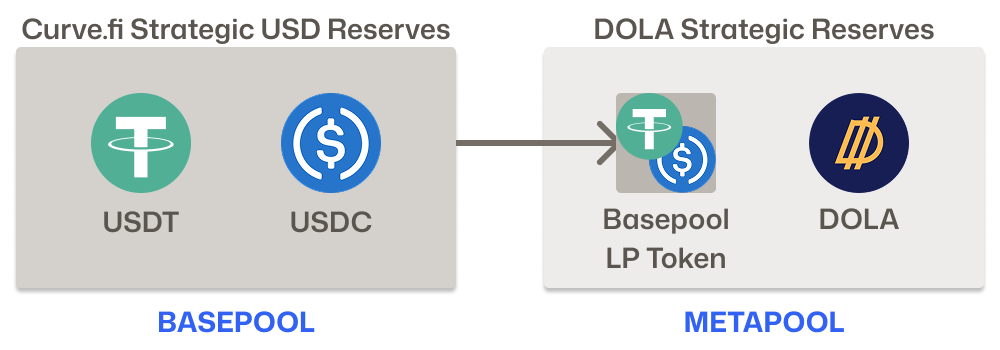
For example, the USDC/USDT pool might begin as a normal Stableswap pool. If the DAO adds it as a base pool, it can then be reused in other pools. A protocol such as Inverse can create a metapool that pairs their stablecoin DOLA against the base pool, resulting in a DOLA–USDC/USDT market. Users can directly swap DOLA/USDT or DOLA/USDC through this pool.
This approach gives new tokens a major advantage: they can **tap into the deep, established liquidity of the base pool** instead of needing to attract all liquidity themselves **by** pairing their token against an already existing and established pool with TVL.