Understanding Stableswap
Historical Background
Curve’s Stableswap algorithm was invented by Michael Egorov, the founder of Curve, in November 2019.
It was introduced in the paper “Stableswap: Efficient Mechanism for Stablecoin Liquidity”, which proposed a new type of Automated Market Maker (AMM) optimized for trading assets pegged to the same value — such as stablecoins (e.g., USDC/USDT) or tokenized versions of the same asset (e.g., wBTC/cbBTC).
The algorithm combines features of both constant sum (fixed swap price) and constant product (x*y=k) curves, allowing for low-slippage trades near the peg while maintaining deep liquidity and arbitrage incentives when prices drift.
In October 2023, the initial Stableswap implementation was reworked into Stableswap-NG, introducing crucial features to further enhance efficiency. More: Evolution Stableswap-NG
How it Works
Stableswap was designed for pools of similarly priced assets, such as stablecoins of the same denomination (e.g., USD), to concentrate liquidity around their pegged price (e.g., USDC/USDT at 1.0). Unlike concentrated liquidity AMMs (CLAMMs) where liquidity providers must actively set price ranges, Stableswap's liquidity concentration is fully passive — users simply deposit tokens, and the protocol automatically concentrates liquidity around the peg through a single continuous bonding curve. No range management or active position adjustments are required.


In this example most of the pool's liquidity (e.g., $40M out of $80M total) is concentrated in a very tight range around the $1.00 price. Each block represents 1 million tokens (1M) of either crvUSD or USDC.
Swap Example:
-
A Stableswap pool has 40M of both crvUSD and USDC, the pool is perfectly balanced, so each asset is $1.
-
A user wants to swap $20M USDC for crvUSD:
- The user's 20M USDC is deposited to the pool
- Approx. 19.98M crvUSD is withdrawn
- The price increases to 1.002 USDC per crvUSD
-
The pool is now imbalanced, it would only take a user selling 9M USDC to push the price up another 0.002. The imbalance also creates an arbitrage opportunity: traders are now incentivized to swap crvUSD back into the pool to get USDC at a slight discount, which naturally pushes the pool back toward a 50/50 balance. Assuming the USDC can be redeemed for its underlying $1 of value.
Stableswap pools function effectively even when heavily imbalanced. Depending on the Amplification Coefficient (A), pools can maintain close to 1:1 pricing even under significant imbalance. If the imbalance causes a price deviation from the peg, it creates an arbitrage opportunity. This incentivizes traders to rebalance the pool, with each swap generating fees for liquidity providers (LPs).
While the blocks offer a helpful visual, Stableswap's liquidity is more accurately represented by a bonding curve:


Supported Asset Types
Stableswap pools support up to 8 assets in a single pool. These can be a range of different types:
- Standard: Normal stable assets. For a USD pool, this includes tokens like crvUSD or USDC. For a BTC pool, this includes WBTC, tBTC, or cbBTC.
- Rebasing: Assets where yield is distributed by automatically increasing the token balance in the user's wallet (e.g., stETH).
- Oracle: Assets whose underlying value increases relative to the peg, utilizing an external oracle to track the exchange rate. This is used for yield-bearing assets that are not ERC-4626 vaults (e.g., wstETH).
- ERC-4626: Also known as Tokenized Vaults. These tokens increase in value over time and utilize the standard
convertToAssetsfunction to track value. They function similarly to Oracle assets but require no configuration due to their standardized structure. Note: these vaults should be strictly increasing in value over time.
Curve allows these different asset types to be integrated into a single pool seamlessly. For example, a valid pool could contain:
- WETH (Standard)
- stETH (Rebasing)
- wstETH (Oracle)
- sfrxETH (ERC-4626 vault)
This configuration creates a highly efficient Stableswap pool. The integration process is streamlined and can be performed directly via the official Curve UI.
Parameters
Amplification Factor (A)
The shape of this liquidity bonding curve and the degree to which a pool can become imbalanced before the price significantly deviates from 1:1 is controlled by the Amplification Factor (A).
For a high-level understanding of A:
- High
Avalues (e.g., 500–10,000) concentrate liquidity tightly around the peg. This provides deeper liquidity for swaps and allows pools to become very imbalanced before the price deviates significantly. The trade-off is that if an asset moves far from the peg, liquidity and pricing drop off sharply. - Lower
Avalues (e.g., 10–100) distribute liquidity more evenly. The price deviates more gradually from the peg as the pool becomes imbalanced, avoiding sharp cliffs.
By definition, the A parameter is a multiplier; it amplifies liquidity around the fair price (usually 1:1) compared to the constant product formula (x*y=k)
We can observe this behavior in a theoretical pool containing crvUSD (pegged at exactly $1.00) and newUSD, where the price of newUSD fluctuates based on the ratio of assets in the pool:
Offpeg Fee Multiplier and Dynamic Fees
The Offpeg Fee Multiplier increases the pool swapping fee if the pool becomes imbalanced (e.g., 90% newUSD and 10% crvUSD). The concept is straightforward:
- When pools become imbalanced, liquidity is in high demand, and LPs should be rewarded for remaining in the pool.
- Swaps that increase the imbalance should incur a higher fee than swaps that rebalance the pool.
The Offpeg Fee Multiplier represents the maximum factor by which the base fee can be multiplied. The dynamic fee is calculated based on the average balance of the pool before and after the swap; consequently, it is cheaper to perform a swap that balances the pool compared to one that increases imbalance.
The chart below demonstrates how this mechanism functions. Note that base fees and offpeg multipliers are fully customizable; the examples below illustrate a range of potential configurations:
Basepools and Metapools
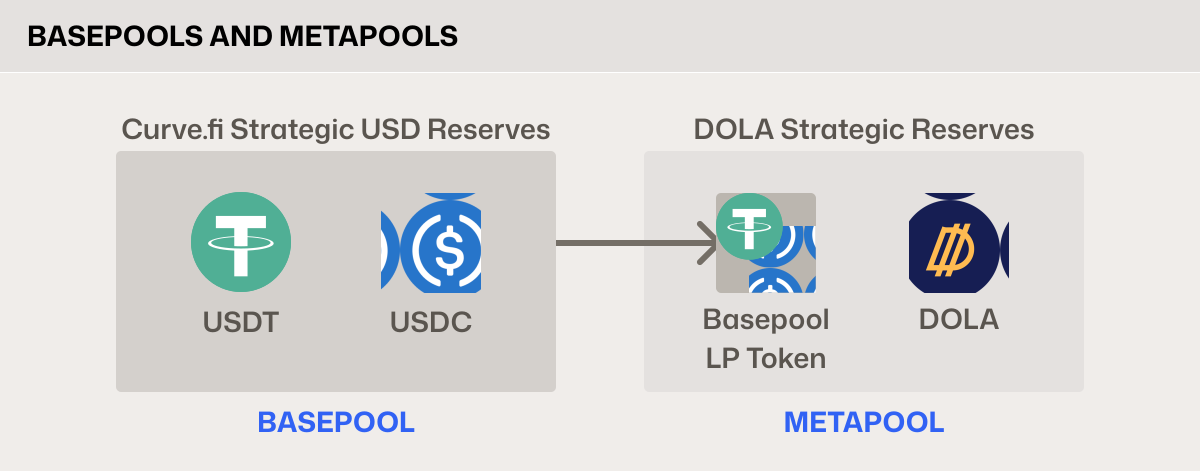
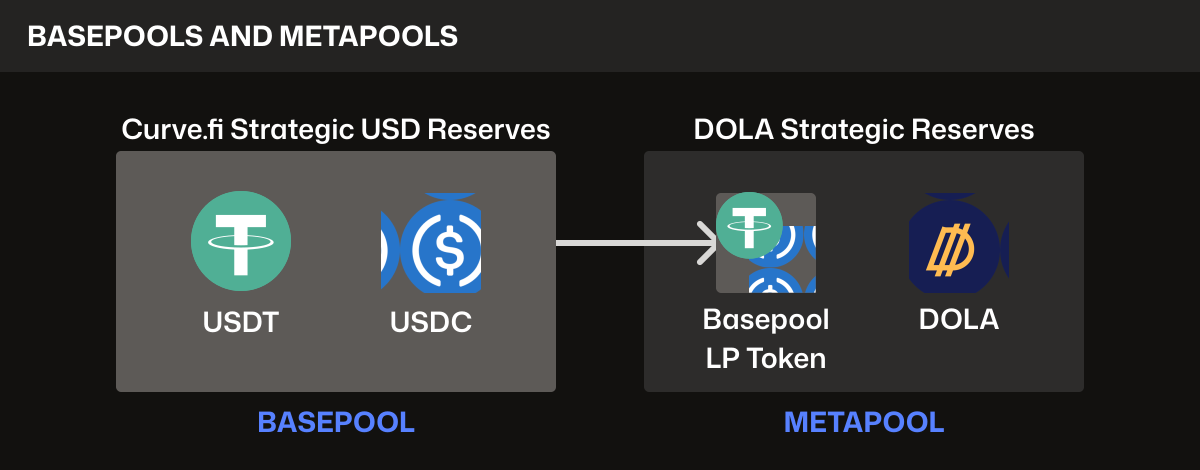
Basepools form a foundational liquidity layer on Curve, composed of widely-used, highly-liquid stablecoins. Anyone can permissionlessly build new liquidity pools - called Metapools - on top of a Basepool.
A Metapool combines a asset with the LP tokens of an existing Basepool. This structure allows Metapools to instantly benefit from the liquidity and stability provided by the underlying Basepool.
See the image below for a visual representation of the Curve.fi Strategic USD Reserves Basepool and the DOLA Strategic Reserves Metapool:
In the above structure:
- Basepool: When USDC and USDT have equal value, liquidity will naturally balance to 50% USDC and 50% USDT.
- Metapool: When DOLA, USDC, and USDT all have equal value, liquidity will naturally balance to 50% DOLA, 25% USDC, and 25% USDT (via Basepool LP tokens).
Benefits of Basepools and Metapools
Curve’s Basepool-Metapool architecture offers distinct benefits for liquidity providers (LPs), stablecoin issuers, and traders:
- Deep Liquidity & Low Slippage: Metapools directly benefit from the liquidity of Basepools, resulting in lower slippage even for newly issued or less liquid stablecoins.
- Risk Isolation: LPs in Basepools aren’t directly exposed to tokens within the Metapools, minimizing their risk. Metapools are also isolated from each other; the only shared risk is de-pegging risk of Basepool assets, which is why adding new Basepools requires a DAO vote.
- Positive Liquidity Loop (Reflexivity): Deposits into Metapools also increase liquidity within Basepools. This creates a positive feedback loop that enhances overall liquidity and trading efficiency across all pools.
- Built-in Yield Generation: Basepool LP tokens continuously earn trading fees. Since Metapools hold these LP tokens, Metapool LPs automatically receive a portion of the Basepool’s trading yield, providing immediate organic returns even before trading volumes pick up.
- Seamless Stablecoin Integration: Stablecoin issuers can permissionlessly pair their tokens with a Basepool, accelerating their token’s liquidity and adoption within the Curve ecosystem.
Basepool List
| Network | Basepool |
|---|---|
 Ethereum Ethereum | DAI/USDC/USDT |
| Ethereum | PYUSD/USDC |
| Ethereum | FRAX/USDC |
| Ethereum | USDC/USDT |
 Arbitrum Arbitrum | USDC.e/USD₮ |
| Arbitrum | FRAX/USDC.e |
 Optimism Optimism | DAI/USDC.e/USDT |
 Gnosis Gnosis | WXDAI/USDC/USDT |
Vault Assets & Assets with Oracles
These asset types are to allow the assets with underlying accruing interest to be added and work natively in a Stableswap pool. The vault or oracle let's the pool know the true value of the underlying asset against other assets in the pool, so as it accrues interest, the pool stays balanced around the true value price of each asset.
Swiss Stake, the service provider developing Curve's technology, offers consulting services to guide protocols and asset issuers in the design and integration of price feed oracles for StableSwap liquidity pools. Additionally, Swiss Stake provides thorough audits of client-implemented oracle solutions to ensure correctness and security. Inquiries: [email protected].
Tho achieve this, the Stablswap pool needs to shift it's center of liquidity (balanced price) over time as the oracle or vault asset accrues interest. Let's have a look at how Stableswap deals with this in practice. Here is the live crvUSD/sUSDe pool over the past year, note how as the fundamental value of sUSDe increases, Stableswap changes the center of liquidity to this new price:
Oracles
Specification Example
While ERC-4626 vaults configure their oracles automatically, the Oracle asset type requires manual setup. This allows any token to be used, provided an accompanying oracle is specified that reports the asset’s value per token relative to the pool’s base unit (must return 18-decimal precision).
For example, in a WETH/wstETH pool, the oracle reads the stEthPerToken() function. This tells the pool that 1 wstETH represents a fixed amount of underlying ETH, ensuring liquidity is centered around the correct value (for example, ~1.12 ETH) rather than 1.0.
Configuration Example (wstETH):
Best Practices for Oracles
When integrating an oracle, the safety of the pool depends entirely on the oracle’s resistance to manipulation and the behavior of its updates.
Best Practices:
- Prefer value-accruing assets: Assets whose value per token increases slowly and predictably (such as most ERC-4626 vaults or liquid staking derivatives, e.g., wstETH, scrvUSD) are best suited for oraclized Stableswap pools.
- Use rate smoothing or limits: If the underlying asset value can change, the oracle should apply smoothing or enforce a maximum change per update so that large jumps are spread over time. See The Sandwich Rule.
- Ensure consistent units: Oracle outputs must be normalized to the same base unit as the rest of the pool (for example, ETH or USD) and returned with exactly 18 decimals.
Dangers:
- Never Use Spot Prices: Do not use the spot price from any DeFi pool, these are highly manipulatable. TWAPs/MAs of the spot price can be OK.
- Never use withdrawal simulations: Functions such as
calc_withdraw_one_coin()or similar balance-based simulations are easily manipulable and must never be used as oracle inputs. - Never Use Spot Balances: Do not rely on spot token balances to calculate value.
- Avoid low-liquidity sources: Do not derive an oracle from a market with less value than the Curve pool it secures.
Oracle Risks & Limitations
Since Stableswap centers liquidity around a specific value p, any update to that value directly shifts the pool’s pricing. If oracle updates are too large or too fast, liquidity providers will incur guaranteed losses.
1. The Oracle Sandwich (2× Fee Rule)
The most critical risk in Stableswap-NG oracles is the "Oracle Sandwich." When an oracle updates the price p on-chain, the pool's internal exchange rate shifts instantly.
If the price shift is larger than the cost of swapping (fees), an attacker can guarantee a profit and cause a loss for LPs by:
- Front-running: Buying the asset before the oracle update.
- Oracle Update: The oracle transaction executes, shifting the price up.
- Back-running: Selling the asset after the update at the new higher price.
To prevent this, you must adhere to the Safe Limit Rule:
The oracle price used by the pool should never change by more than 2x the pool fee in a single block. For example, if your base pool fee is 0.04%, the oracle should not shift by more than 0.08% per block. If the market moves 5%, your oracle contract should "smooth" this movement over many blocks.
2. Dynamic Fees Do Not Protect Against Oracle Attacks
Stableswap-NG includes dynamic fees that increase when token balances become imbalanced. These fees are not designed to protect against oracle-driven price shifts.
Oracle updates change the value of balances, not the token amounts. As a result, the pool may appear perfectly balanced to the fee logic while still being exploitable.
3. Unsuitability for Volatile Assets
Stableswap-NG is optimized for assets whose relative value changes slowly. It is not recommended for volatile asset pairs.
Frequent oracle updates force the pool to repeatedly re-center its liquidity, which mathematically causes liquidity providers to sell the appreciating asset at a discount. Over time, this leads to persistent LP losses unless offset by higher fee generation or incentives.
For volatile pairs, prefer Cryptoswap or FXSwap pools, which are designed specifically for such use cases.
Read more about best oracle practices and risks here: MixBytes: Safe StableSwap-NG Deployment: How to Avoid Risks from Volatile Oracles
Swiss Stake, the service provider developing Curve's technology, offers consulting services to guide protocols and asset issuers in the design and integration of price feed oracles for StableSwap liquidity pools. Additionally, Swiss Stake provides thorough audits of client-implemented oracle solutions to ensure correctness and security. Inquiries: [email protected].